Smart Warehouse Solution

Smart warehousing is built on a technology foundation of the Internet of Things (IoT), artificial intelligence (AI), and big data. It achieves interconnection among devices such as smart sensors, Automated Guided Vehicle (AGV) robots, and automated storage racks, enabling real - time collection of full - dimensional data including inventory dynamics, storage location status, and operation trajectories.
Powered by the algorithm engine of the Warehouse Management System (WMS), it automatically accomplishes tasks like inbound Stock Keeping Unit (SKU) identification, dynamic storage location allocation, picking path planning, and outbound error - proofing verification, replacing manual experiential decision - making.
From intelligent storage planning for incoming goods, optimal path calculation for picking and distribution, to dynamic monitoring of inventory levels and abnormal warning, it realizes automated flow, intelligent decision - making, and efficient collaboration in warehouse operations.

Smart Warehouse

Core Pain Points
1. Hardware like automated storage and retrieval systems (AS/RS), AGVs, and sorters lacks unified coordination, leading to frequent task conflicts and resource idleness.
2. Storage location allocation, order fulfillment, and task scheduling rely on manual judgment, which is error - prone and slow to respond, failing to match the demands of high - tempo production.
3. Data on inventory status, equipment operation, and task progress is scattered and hard to synchronize timely, causing delayed replenishment, lagging scheduling decisions, and low inventory turnover.
4. When equipment malfunctions or tasks change, there’s no automatic warning or self - healing mechanism, and manual troubleshooting delays production.
Solution Approach
hrough “hardware interconnection → data integration → algorithm - driven scheduling → business closed - loop”, an intelligent system replaces manual decision - making. Data flow breaks coordination barriers, upgrading warehouse operations from “experience - driven” to “data + algorithm - driven”. This precisely resolves pain points like isolated equipment, low efficiency, and delayed decision - making.

Product Architecture of the Solution

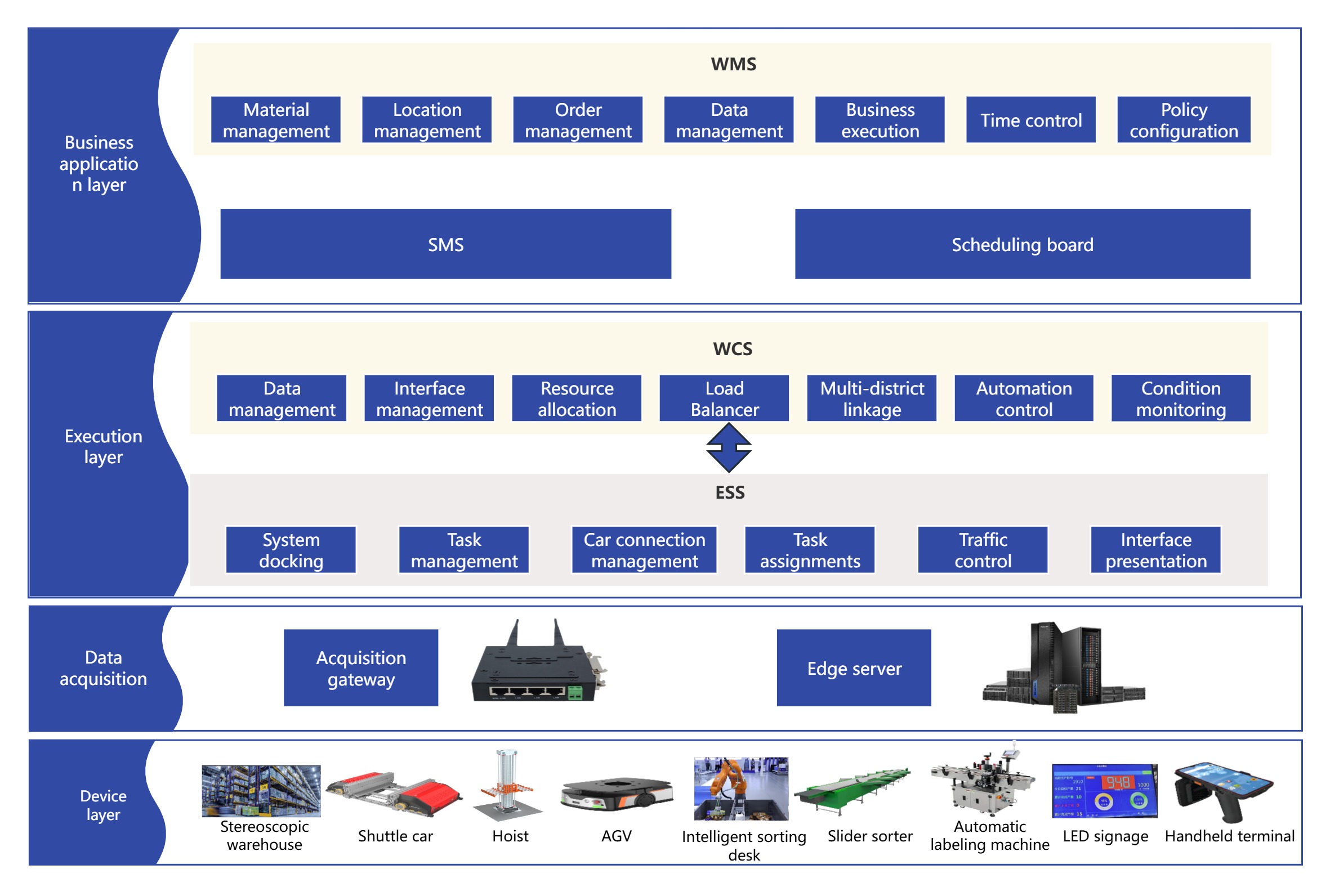
The smart warehousing solution has a four - layer architecture: The device layer connects hardware such as stereoscopic warehouses and AGVs, linked via gateways/edge servers in the data collection layer; the execution layer’s WCS is responsible for resource scheduling and multi - zone linkage, while ESS monitors task and equipment status; the business layer’s WMS coordinates core businesses like materials and orders, with SMS and scheduling dashboards assisting in execution. This achieves hardware interconnection, data integration, and intelligent collaboration.

Unmanned Loading & Unloading

Core Pain Point

Labor & Cost Issues
Labor shortages and surging labor costs stem from aging populations. Tough, harsh loading work fails to attract young staff.
Efficiency & Quality Issues
Manual handling is slow and experience-dependent. Fatigue reduces output by 40%, causing low filling rates, unbalanced and overloaded cargo.
Safety Risks
Loading sites see frequent work injuries from falling goods and equipment clashes. Dusty port conditions harm workers’ health.
Adaptability Limits
Traditional systems require perfect working conditions and cannot cope with skewed trucks, dark containers and mixed cargo sizes.

Solution

Unmanned loading/unloading relies on intelligent, standardized machines to replace manual labor and experience. Equipment imitates human decision-making with superior stability and precision.
  1. 1.Environmental self-adaptation: 3D vision and LiDAR identify misparked trucks, dark containers and irregular goods without ideal parking conditions.
  2. 2.Autonomous planning: Real-time data enables machines to calculate optimal pick and stack schemes instead of fixed routines.
  3. 3.Ultra-precise movement: Centimeter-level control avoids cargo collisions and unbalanced loads.
  4. 4.Full system interconnection: Integrated with WMS and order systems to build an end-to-end data loop.

Application Scenarios of Unmanned Loading & Unloading

特色介绍

Automatic Unloading for Box Trucks

特色介绍

Loading of Cartons in Assorted Sizes

特色介绍

Automatic Loading for Wing-Van Trucks

沪ICP备2025124812号