Intelligent Factory Solutions

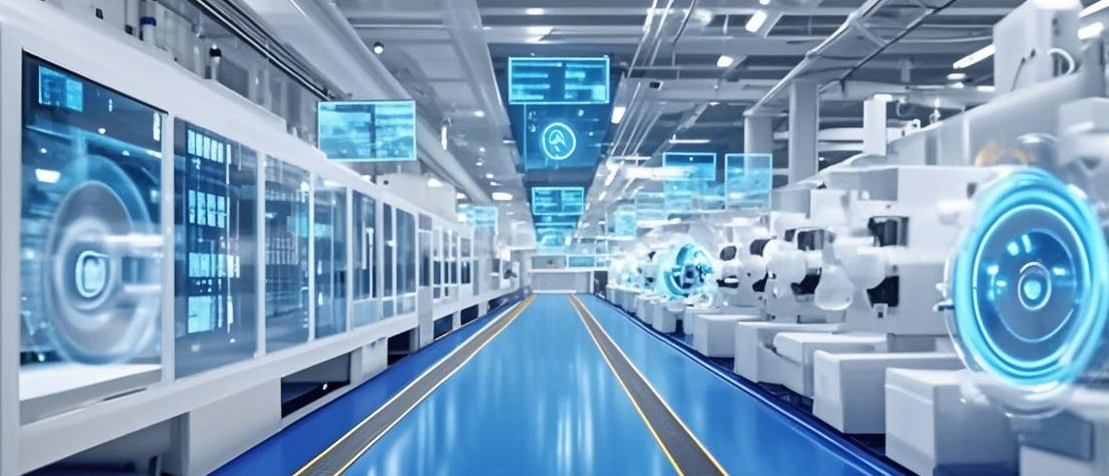
Vezu provides intelligent factory solutions for manufacturing clients, integrating digital twin, AI, 5G, and other technologies to cover the full lifecycle from diagnostics and planning to technology implementation and continuous operations. We help achieve production efficiency improvement, cost reduction, and the construction of flexible manufacturing capabilities and green low-carbon systems, empowering enterprises to create world-class smart factory benchmarks.

Smart Factory Planning and Implementation Methodology

The planning and implementation of a smart factory are complex systematic projects that require integrating technical, management, and business needs while following a scientific methodology. Smart factory construction should adhere to the closed-loop logic of "assessment - planning - implementation - iteration," select technical paths (such as digital twin or industrial internet) based on enterprise realities, and emphasize organizational transformation and ecological collaboration. Future trends will place greater emphasis on AI-driven adaptive manufacturing and industrial chain-level collaborative innovation, requiring enterprises to continuously monitor policy guidance and technological evolution and dynamically optimize planning paths.
  • Planning Phase: Systematic Framework Development

  • Implementation Phase: Step-by-Step Deployment and Dynamic Optimization

  • Support Measures: Multi-Dimensional Support System

    • Current Status Assessment and Gap Analysis
      • Business and technical level assessment: Identify existing issues by surveying enterprise strategy, production processes, automation level, and data governance capabilities.
      • Maturity benchmarking: Evaluate the enterprise's digitalization level in R&D, production, logistics, and other links against national standards such as the Smart Manufacturing Capability Maturity Assessment Methodology to clarify improvement directions.
      • Needs Analysis and Scenario Design
      • Needs sources: Include strategic transformation needs (e.g., service-oriented transformation), group control needs (e.g., financial centralization), and technology-driven needs (e.g., AI and IoT applications).
      • Scenario construction: Design business digital transformation scenarios (e.g., shifting from "maintenance-based" to "predictive maintenance"), distinguish short-term and long-term scenarios, and use visualization tools (e.g., digital twin) to demonstrate comparisons between old and new models.
    • Blueprint and Architecture Design
      • Goal stratification: Set long-term goals (e.g., full-process unmanned operation) and short-term goals (e.g., key process automation), and design the overall architecture (software, automation, data architecture).
      • Specialized planning: Focus on eight core areas, such as automation and reduced manning, intelligent logistics, and R&D innovation, and select priorities based on enterprise realities.
    • Solution Design and Path Planning
      • Technology selection: Introduce digital twin and industrial internet platform technologies to optimize production process simulation and real-time monitoring.
      • Implementation roadmap: Define 3-5-year phased goals, set priorities for business modules (e.g., automation before intelligence), and ensure resource alignment (budget, personnel).
    • Core Construction Content
      • Flexible automated production lines: Deploy modular equipment and adaptive control systems to support multi-variety, small-batch production.
      • Data governance and integration: Collect equipment, quality, and energy consumption data via IoT to build a unified data platform (e.g., MES+ERP integration) for full-process traceability.
      • Intelligent logistics system: Apply AGVs and smart warehousing to optimize material flow efficiency and reduce ineffective handling.
    • Project Deployment and Iteration
      • Pilot first: Prioritize key workshops or production lines to validate technical feasibility.
      • Dynamic adjustment: Regularly assess project progress and adjust plans according to technological evolution (e.g., AI algorithm upgrades) to avoid disconnection from reality.
    • Organizational and Talent Support
      • Establish a digital transformation committee to clarify cross-departmental collaboration mechanisms.
      • Conduct employee skill training (e.g., data analysis, equipment maintenance) to avoid the "technology-over-talent" pitfall.
    • Standardization and Security System
      • Follow the National Smart Manufacturing Standard System Construction Guidelines to establish enterprise-level standards (e.g., data interface specifications).
      • Build a cybersecurity protection system to prevent data leaks and production disruptions.
    • Economic Feasibility and Sustainability
      • Evaluate ROI (e.g., return on investment cycle for automated equipment) to avoid blind pursuit of technological stacking.
      • Adopt green processes and energy management systems to achieve low-carbon production.

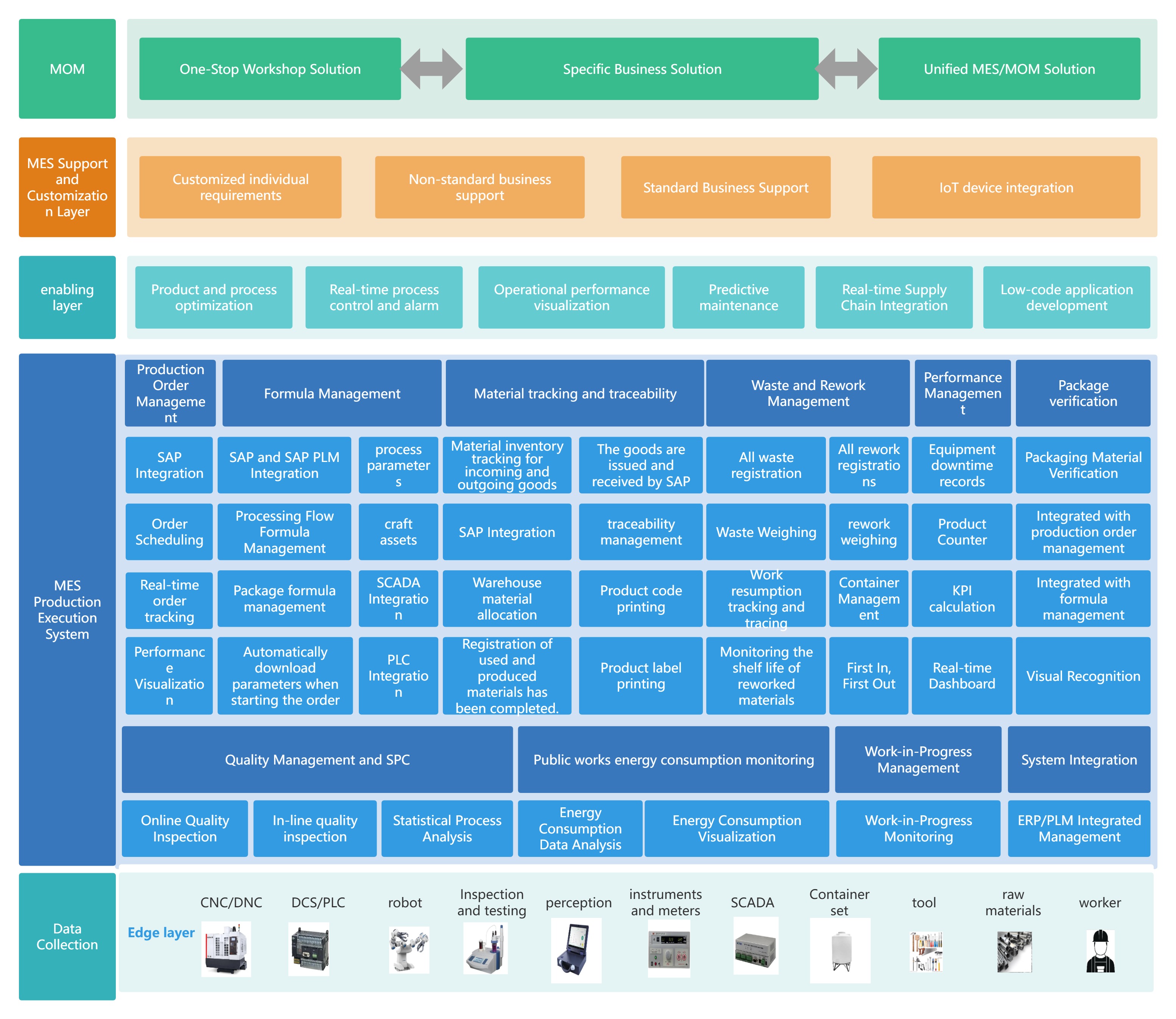
MES/MOM System for Smart Factories

We help clients optimize existing MES and MOM systems, conduct needs analysis, and assist in deploying customized MES and MOM solutions to enhance production efficiency and management levels. Through digital and intelligent technologies, we achieve transparency and automation in production processes, reduce manual intervention, and improve operational efficiency.

Smart energy solution

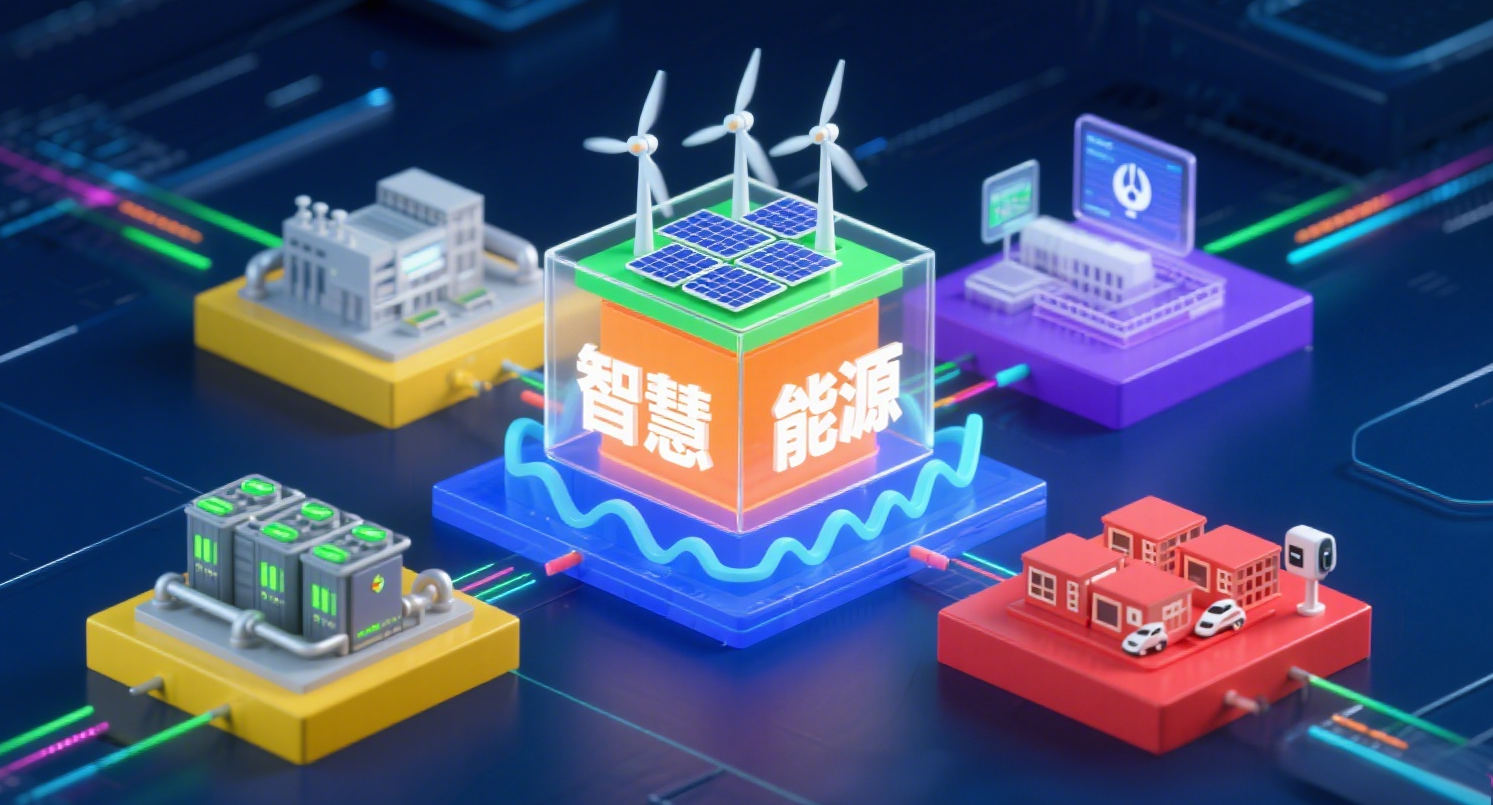
Smart energy leverages technologies such as the Internet of Things (IoT), big data, and artificial intelligence to conduct full - dimensional, real - time monitoring and intelligent management of various energy consumptions (water, electricity, gas, heat, etc.) in scenarios like buildings, industries, and parks. Through smart sensing devices, energy consumption data is collected, and combined with algorithmic analysis to uncover energy consumption patterns and waste nodes. This enables dynamic regulation (e.g., optimized equipment start - stop, adjusted load distribution), anomaly warning, and energy efficiency evaluation. It not only helps users accurately reduce energy consumption costs but also drives low - carbon transformation through data - driven energy - saving strategies, providing quantifiable and operable technical support for the implementation of refined energy management.

Smart Energy

Core pain points

1. Energy devices (e.g., electric meters, air compressors, HVAC systems) are diverse, lacking unified data collection methods. Severe data silos exist, making it impossible to grasp the real - time overall energy consumption of the entire plant.
2. Manual energy data statistics are inefficient; abnormal leaks and overloads are hard to warn about in a timely manner. Coordinated scheduling of multiple energies like electricity, water, and gas is complex, leading to lagging responses to production fluctuations.
3. Energy - saving strategies rely on manual experience. There’s a lack of AI - driven dynamic energy consumption prediction, root - cause analysis of anomalies, and optimized scheduling, resulting in persistently high energy waste and costs.
4. Data display forms are limited; multi - terminal access is inconvenient, making it difficult to support management’s quick decision - making. The platform has poor scalability, and the development cost of customized energy - saving applications is high.

Solution approach

Smart energy management centers on “full - link digital integration + intelligent closed - loop driving” and progresses in four steps:
Integrate all types of energy devices via the Internet of Things to collect data in real - time and break data silos;
Leverage edge computing and cloud computing to connect data flows, enabling end - to - end management and control to resolve delayed monitoring issues;
The PaaS platform uses low - code tools + AI/knowledge hubs to mine data value, accumulate operational experience, and output dynamically optimized strategies;
The SaaS layer visualizes insights across multiple terminals, converting analytical results into actionable instructions. These instructions trigger coordinated execution and iterative improvement, forming a management closed - loop. This upgrades energy management from “experience - driven” to “data + algorithm - driven”, addressing the needs of cost reduction and efficiency improvement.

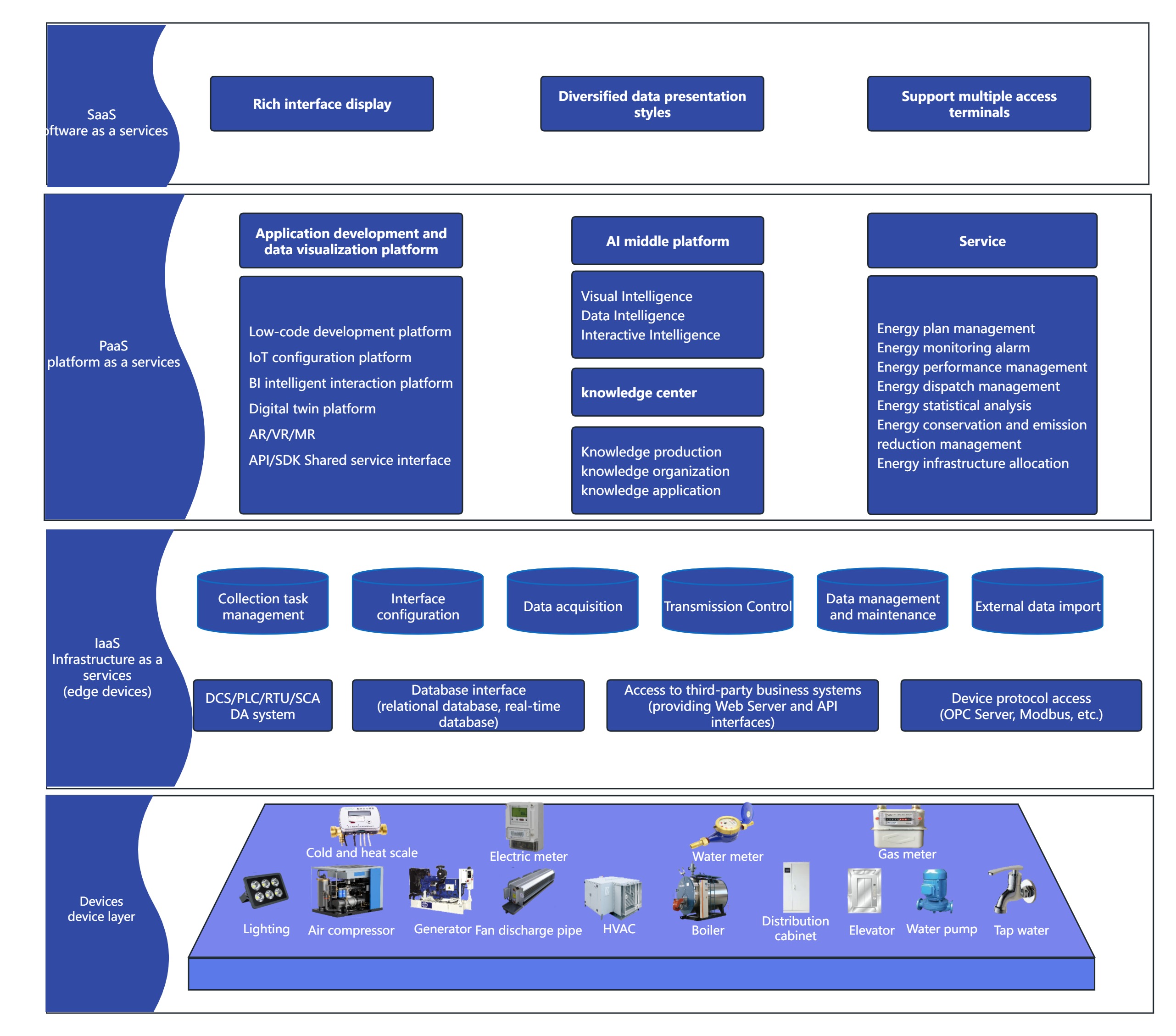
Product Architecture of the SolutionMES/MOM System for Smart Factories

Smart energy management achieves synergy through a four - layer architecture: The device layer connects all types of energy - related equipment; the IaaS layer manages data collection, transmission, and storage to eliminate information gaps; the PaaS layer leverages low - code tools, AI, and a knowledge hub to drive energy consumption optimization; the SaaS layer enables multi - terminal visualization to form a “monitoring - decision - optimization” closed loop. It replaces experiential judgment with data and algorithms to address management pain points.
沪ICP备2025124812号